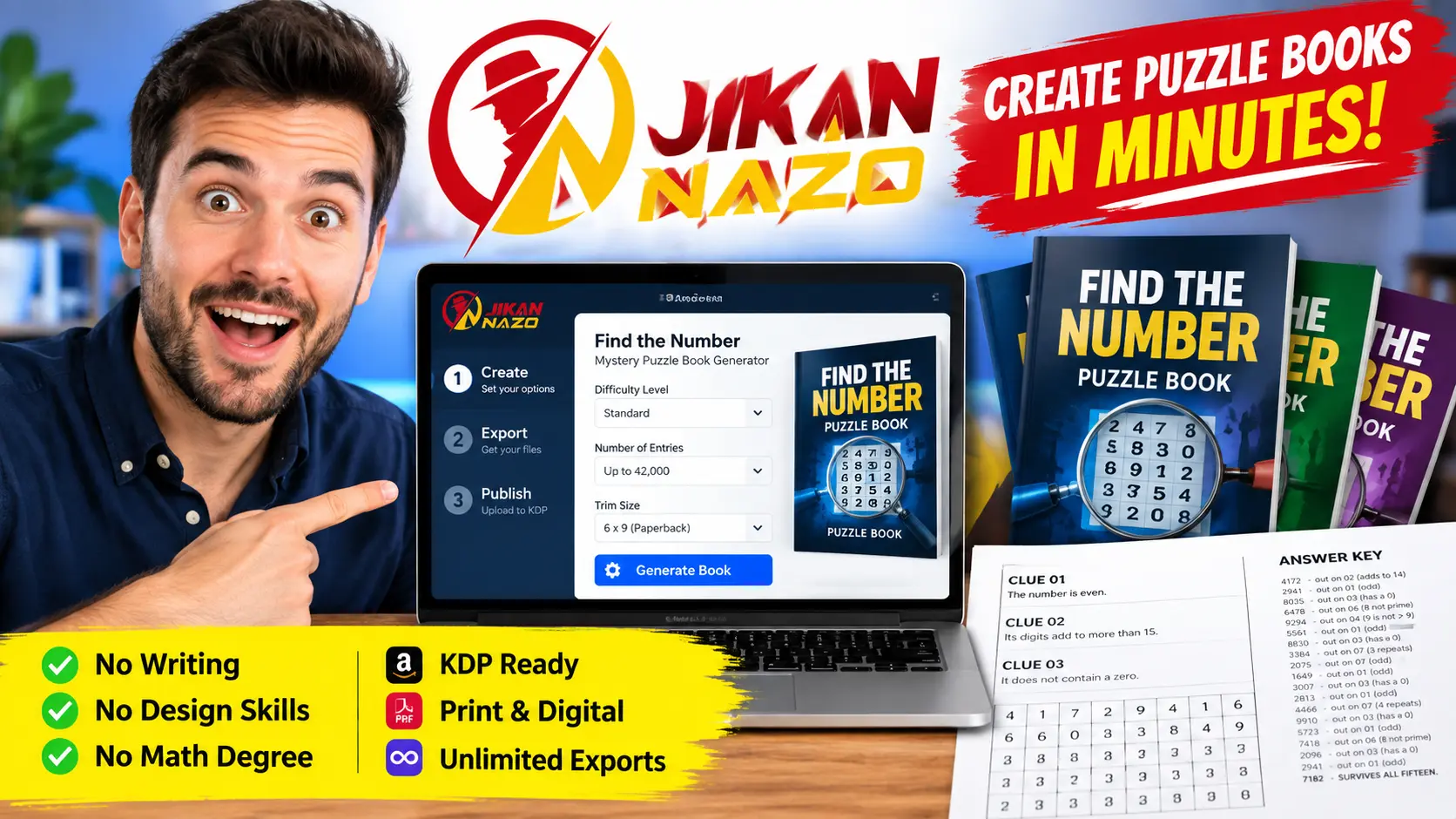
Shigai Royalty Review 2026: Is This Mystery Puzzle Book Creator Really Worth It?
Shigai Royalty Review 2026: Explore its features, KDP workflow, pricing, bonuses, OTOs, commercial rights, pros, cons, and overall value.

Introduction
If you've spent any time researching Amazon KDP, you've probably noticed the same problem: the easiest book categories are often the ones with the most competition.
Sudoku, word searches, coloring books, journals, and generic activity books already have countless titles fighting for attention. Creating another book in one of these categories isn't necessarily difficult. The harder part is giving buyers a reason to choose yours.
That's where Shigai Royalty takes a different approach.
Instead of focusing on another standard puzzle generator, the platform is built around story-driven logic mysteries. The idea combines a traditional whodunit with a deduction puzzle, giving readers suspects, rooms, statements, and clues they must work through to identify the culprit.
The software is also designed to handle much of the production process, including puzzle generation, solution verification, hints, walkthroughs, page design, and file exports.
But there's still one important question:
Does a specialized puzzle-generation tool actually make Shigai Royalty a worthwhile investment for a KDP publisher?
In this Shigai Royalty Review, we'll look at how the platform works, its main features, Shigai Royalty Pricing, KDP capabilities, bonuses, OTOs, commercial rights, potential advantages, limitations, and the type of publisher most likely to get value from it.
Disclosure: This review is based on the product information and sales material available for analysis. Features, pricing, bonuses, licensing terms, and availability can change. Any income examples or testimonials should not be treated as typical or guaranteed results.
Ready to Try Shigai Royalty?
If you're interested in creating mystery and logic puzzle books for Amazon KDP, take a closer look at Shigai Royalty and see whether its features fit your publishing plans.
Check the current guarantee and purchase terms on the checkout page before ordering.
30-Day Money-Back Guarantee
What Is Shigai Royalty?
Shigai Royalty is a cloud-based software platform designed to create story-driven logic mystery puzzles for books and printables.
The basic concept is straightforward.
Instead of manually building every puzzle, you create a case around suspects, rooms, objects, and clues. The software then generates a deduction puzzle where readers work through the available information to determine the correct solution.
Imagine a mansion with six suspects.
A series of clues might establish that:
One suspect wasn't in the library.
Another person was seen in the dining room.
Two characters couldn't have occupied neighboring rooms.
A particular room contains the victim.
Several additional clues eliminate possible combinations.
The reader works through the grid, ruling out possibilities until only one logical answer remains.
That gives the puzzle a narrative element you don't normally get from a basic Sudoku or word-search book.
According to the supplied product information, Shigai Royalty is intended to automate some of the harder parts of this process, including generating cases and checking them for a single solution.
Who Is Shigai Royalty For?
The platform appears to be aimed at several types of creators:
Amazon KDP publishers
Puzzle-book creators
Printable sellers
Digital-product sellers
Mystery and puzzle enthusiasts
Entrepreneurs building a puzzle-book catalog
Creators who don't want to construct every puzzle manually
It could be particularly useful for existing KDP publishers who want to build a series of themed mystery books rather than a collection of unrelated puzzle products.
How Does Shigai Royalty Work?
The basic workflow can be summed up as:
Create → Verify → Export → Publish
The appeal is that several tasks that would normally require separate tools are brought together in one platform.
1. Create a Mystery
You choose settings such as difficulty, grid size, characters, rooms, and themes.
The supplied sales material says Shigai Royalty supports grids from 6×6 to 16×16 and offers five difficulty levels, ranging from Easy to Dragon.
That gives publishers several ways to structure their books.
A beginner-focused book could use:
Smaller grids
Fewer suspects
Simpler clues
Shorter deduction chains
An advanced collection could use:
Larger grids
More suspects
More complicated relationships
Longer solving sequences
This becomes more useful if you're planning to build more than one book.
You could create a progression in which readers start with easier cases and gradually move into more challenging mysteries.
2. Generate and Verify the Puzzle
This is arguably the most important part of the Shigai Royalty workflow.
A logic puzzle needs a clear answer.
If two solutions are possible, the reader can reasonably conclude that the puzzle is flawed. If no solution exists, the puzzle simply doesn't work.
According to the product's claims, its deduction engine mathematically checks each puzzle to ensure there is exactly one solution that can be reached through deduction.
That's a meaningful production advantage if the feature performs as described.
Creating complicated logic puzzles by hand isn't just time-consuming. It's also easy to overlook an unintended solution.
Still, automated verification shouldn't replace final human review.
Before uploading a book to Amazon KDP, I'd check the generated material for:
Instructions
Clue wording
Solutions
Page order
Formatting
Translations
Images
Printing issues
The idea is to let the software handle repetitive production work while you take care of the final quality checks.
3. Export the Book
Once the puzzles are ready, the built-in page designer is intended to turn them into a finished interior.
The supplied information lists features such as:
KDP-oriented layouts
Trim sizes
Margins
Fonts
Difficulty badges
Puzzle grids
Legends
Solution pages
PDF exports
High-resolution PNG exports
Bulk generation
For someone new to KDP, having these tasks in one workflow could be easier than switching between a puzzle generator, design application, PDF editor, and several other tools.
Shigai Royalty Features
The software's appeal isn't limited to puzzle generation. Several additional features are designed to help turn individual puzzles into complete products.
Verified Deduction Engine
The deduction engine is the core of the platform.
Shigai Royalty claims to generate mystery logic puzzles and verify that each one has a unique solution.
For publishers, that addresses one of the biggest challenges with manually created logic puzzles: quality control.
A puzzle book containing incorrect or ambiguous puzzles can quickly lead to frustrated readers and negative reviews.
Of course, the software's verification claim should still be backed up with your own testing before publication.
Five Difficulty Levels
The platform advertises five difficulty levels, from Easy to Dragon.
That gives you room to create books for different types of puzzle solvers.
For example, a series could progress through:
Beginner → Intermediate → Advanced → Expert → Dragon
That kind of progression could also help you build a recognizable product line instead of relying on a single standalone title.
6×6 to 16×16 Grids
According to the supplied sales information, users can work with grids ranging from 6×6 to 16×16.
Smaller grids may be better suited to beginners, while larger grids leave more room for complicated deduction.
The real advantage isn't simply having multiple grid sizes. It's being able to match the grid with the intended difficulty and audience.
Custom Characters and Rooms
Another interesting feature is the ability to customize characters and room names.
That creates plenty of room for themed books.
Potential concepts include:
Victorian mansion mysteries
Cozy village cases
Hotel investigations
Office mysteries
Cruise-ship puzzles
Haunted-house cases
Holiday mysteries
The more specific the theme, the easier it can be to give the book a distinct identity.
Hints and Solution Walkthroughs
The platform also provides hints and step-by-step solution walkthroughs.
That's useful because not every reader wants to sit with a difficult puzzle until they eventually give up.
A good structure might be:
Hint 1 → Hint 2 → Hint 3 → Full Solution
This gives readers several opportunities to keep solving without immediately revealing the complete answer.
KDP Page Designer
The built-in page designer is another practical feature.
Instead of exporting raw puzzles and then manually rebuilding every interior page in another application, publishers can reportedly handle the layout inside the platform.
For beginners, that could reduce some of the technical friction involved in preparing a KDP interior.
PDF and PNG Exports
Shigai Royalty advertises print-ready PDF and high-resolution PNG exports.
That creates possibilities beyond Amazon KDP.
Depending on marketplace rules and your licensing rights, the same underlying puzzle content could potentially be adapted into:
KDP paperback books
Printable PDF products
Puzzle bundles
Activity packs
However, don't assume one file can simply be uploaded everywhere without changes. Each platform has its own specifications and policies.
Eight Book Languages
The supplied product information lists eight supported languages:
English
Spanish
French
German
Italian
Portuguese
Dutch
Polish
For a U.S.-focused publisher, English would naturally be the most logical place to begin.
Multilingual support could become more useful after you've validated a concept and want to experiment with additional markets.
I'd still recommend reviewing translated clues and instructions manually. A translation can be technically correct and still sound unnatural to a native reader.
Ready to Try Shigai Royalty?
If you're interested in creating mystery and logic puzzle books for Amazon KDP, take a closer look at Shigai Royalty and see whether its features fit your publishing plans.
Check the current guarantee and purchase terms on the checkout page before ordering.
30-Day Money-Back Guarantee
Shigai Royalty Pricing: What Does It Cost?
The sales material supplied for this review emphasizes launch pricing rather than giving a permanent retail price.
It also states that the promotional price can increase when the launch timer resets.
That means the exact amount shouldn't be treated as a fixed long-term price.
If you're considering a purchase, check the current checkout page for the price actually being offered at that time.
More importantly, think about how much use you'll get from the software.
Someone planning to create one puzzle book has a very different value calculation from someone who wants to build a larger catalog.
Ask yourself:
How many books do I realistically intend to create?
Will I use the software repeatedly?
Am I already publishing on KDP?
Do I have a clear niche strategy?
Am I comfortable handling covers, listings, and marketing?
A low-priced tool isn't much of a bargain if it ends up sitting unused.
What About Shigai Royalty OTOs?
The supplied sales material doesn't provide enough information to confirm a complete list of Shigai Royalty OTOs.
An OTO, or One-Time Offer, is generally an additional offer shown after the initial purchase. Its price, contents, and availability can vary.
So don't automatically assume that every upgrade is necessary.
Before buying an OTO, consider:
Does it provide functionality you actually need?
Is the feature already included in the main product?
Will it improve your publishing workflow?
Does it remove a limitation you'll realistically encounter?
Are you purchasing because you genuinely need it or because of launch urgency?
That's a much more sensible way to evaluate upsells than treating every offer as essential.
Shigai Royalty Bonus: What's Included?
The launch offer describes several bonuses intended to support the KDP publishing workflow.
PDF Page Mover
This bonus is designed to help users reorder, insert, replace, or remove pages within a PDF interior.
It could come in handy when a book needs a last-minute change without requiring you to rebuild the entire interior.
KDP Keyword Finder
The advertised keyword tool is intended to help identify Amazon search terms and populate KDP keyword fields.
Keyword research can be useful, but generated suggestions still need human judgment.
Don't add keywords just because a tool recommends them.
They should accurately reflect the actual contents of your book.
Description Helper
This bonus is designed to assist with writing Amazon book descriptions.
That can be useful when you're managing several books, but I'd still edit the output before publishing.
Your description should sound like it was written for the buyer, rather than simply generated to fill a metadata field.
QR Book Generator
The QR-code generator could be useful for linking readers to appropriate bonus material, resources, or other permitted destinations.
However, always check Amazon KDP's current content and linking requirements before adding promotional material to a book.
KDP Research and Niche Tool
The sales page also promotes a research tool intended to help identify KDP niches and products that may have market demand.
This could be one of the more strategically useful bonuses because research should happen before production.
There isn't much value in creating dozens of books first and only afterward discovering that the niche isn't attractive.
Can You Really Make Money With Shigai Royalty?
This is where a realistic review needs to separate software functionality from business results.
Shigai Royalty may make the production side of mystery puzzle publishing easier.
That doesn't mean the software itself creates demand.
Your actual results could depend on:
Niche selection
Book quality
Cover design
Amazon search visibility
Pricing
Competition
Reviews
Metadata
Positioning
Customer demand
Publishing consistency
The supplied sales page includes member testimonials and income-related examples, but it also states that results vary.
So I wouldn't approach Shigai Royalty as an automatic-income system.
A more realistic way to look at it is as a production tool.
If the software helps you create better puzzle books faster, you can spend more of your time on the areas it can't handle for you—research, positioning, publishing, and marketing.
A Practical Shigai Royalty Publishing Strategy
If I were testing the software for a U.S. KDP business, I wouldn't jump straight into generating 50 books.
I'd validate one concept first.
Step 1: Research the Market
Search Amazon for existing mystery and logic puzzle books.
Pay attention to:
Titles
Covers
Page counts
Ratings
Customer reviews
Prices
Difficulty levels
Themes
Intended audience
Don't simply copy the books that are already ranking.
Look for gaps.
For instance, if broad mystery puzzle books are crowded, a narrower theme could give you a clearer position.
Step 2: Choose One Specific Theme
Instead of publishing a generic "Murder Mystery Puzzle Book," consider a more defined concept such as:
Victorian Mansion Mystery Puzzles
or
Cozy Village Detective Logic Puzzles
The goal isn't to make the title complicated.
It's to make the product immediately understandable to someone browsing Amazon.
Step 3: Build a Small Test Book
Start with a manageable collection instead of trying to create a huge catalog immediately.
A 20–30-puzzle test book gives you an opportunity to examine:
Puzzle logic
Instructions
Clues
Solutions
Formatting
Typography
Cover quality
Page numbering
Print appearance
If the concept performs well, you can expand from there.
Step 4: Test the Customer Experience
Don't rely solely on the software's verification.
Solve several puzzles yourself.
Better yet, ask someone else to solve them without giving additional explanations.
If they repeatedly struggle to understand what they're supposed to do, the problem may be the instructions rather than the puzzle itself.
Step 5: Build a Series
If the first concept gains traction, expand it into related books.
For example:
Book 1: Beginner Cases Book 2: Holiday Mysteries Book 3: Victorian Cases Book 4: Haunted Mansion Cases Book 5: Expert Investigations
A connected series can give readers a reason to purchase another book after finishing the first one.
Common Shigai Royalty Mistakes to Avoid
Publishing Too Quickly
Automation can make production faster.
That doesn't mean you should publish every file the moment it has been generated.
Read it. Test it. Inspect it.
Your name is ultimately attached to the finished product.
Chasing Every Possible Niche
Custom characters and themes give you flexibility, but that doesn't mean you need to create books for every audience you can imagine.
Start with one clearly defined concept.
Validate it.
Then expand.
Ignoring Cover Design
A strong puzzle interior can't make up for a weak cover.
On Amazon, your cover competes for attention in search results alongside many other books.
Make the subject, audience, and general puzzle concept easy to understand at a glance.
Keyword Stuffing
Don't turn your title or description into a list of repeated keywords.
Something like:
"Mystery Puzzle Book Logic Puzzle Mystery Book Logic Mystery Puzzles..."
isn't useful to a buyer.
Use natural language and make sure your metadata accurately describes the book.
Relying Entirely on Automation
Automation should reduce repetitive work, not remove human judgment.
You should still review:
Grammar
Translations
Puzzle instructions
Solutions
Layout
Images
Copyright considerations
KDP requirements
That's particularly important when publishing for the U.S. market, where Amazon KDP's current content and formatting requirements need to be followed.
Shigai Royalty Pros and Cons
| Pros | Cons |
|---|---|
| Specialized mystery-puzzle concept | Sales aren't guaranteed |
| Automated puzzle generation | Requires quality control |
| Claims unique-solution verification | Promotional pricing can change |
| Multiple difficulty levels | Competition can increase |
| Custom characters and rooms | Learning the workflow still takes time |
| KDP-focused page tools | Market research is still necessary |
| PDF and PNG exports | Software doesn't replace marketing |
| Multiple languages | Translations should be reviewed |
| Potentially useful for building a catalog | Results vary by publisher |
Is Shigai Royalty Worth It?
Shigai Royalty may be worth considering if you specifically want to build a catalog of logic-based mystery puzzle books and want to automate part of the production process.
Its strongest selling point isn't the promise of effortless passive income.
It's the attempt to solve a difficult production problem:
How do you create and verify story-driven logic puzzles without constructing every case manually?
For KDP publishers who don't have puzzle-design experience, that could be genuinely useful.
But expectations matter.
Shigai Royalty won't eliminate the need to:
Research demand
Select appropriate niches
Create appealing covers
Review generated content
Follow Amazon KDP requirements
Write accurate metadata
Set sensible prices
Build a publishing strategy
In other words, the software can potentially help with production, but it doesn't replace publishing expertise.
Who Should Consider Shigai Royalty?
Good Fit
Shigai Royalty could be worth exploring for:
New KDP publishers interested in puzzle books
Existing puzzle-book publishers
Mystery enthusiasts
Printable creators
Digital-product sellers
Publishers planning themed puzzle series
Creators who want a faster production workflow
Probably Not a Good Fit
It may not be suitable for someone who:
Wants guaranteed income
Doesn't want to review generated content
Expects instant passive income
Has no interest in KDP or printable products
Doesn't want to research markets
Expects software alone to generate sales
Frequently Asked Questions About Shigai Royalty
What is Shigai Royalty?
Shigai Royalty is a cloud-based software platform designed to generate story-driven logic mystery puzzles and prepare them for books or printable products.
Does Shigai Royalty work with Amazon KDP?
Yes. The product is specifically marketed toward KDP publishers and includes tools designed to create KDP-oriented puzzle-book interiors and exports. However, publishers should always check Amazon's current specifications before uploading.
Does Shigai Royalty create unique-solution puzzles?
According to the supplied product information, its deduction engine verifies puzzles for exactly one solution. Even so, reviewing the finished book before publication remains a sensible quality-control step.
Does Shigai Royalty include commercial rights?
The sales page states that the offer includes full commercial rights for books created using the software. Before selling commercially, review the current license terms to make sure your planned use is covered.
Are Shigai Royalty OTOs required?
There is no reason to assume that OTOs are required. They are generally additional offers, and each should be evaluated based on whether its features are useful for your particular publishing strategy.
Final Verdict: Should You Buy Shigai Royalty?
Shigai Royalty is an interesting KDP-focused tool because it approaches puzzle publishing from a less conventional direction.
Rather than concentrating on another generic Sudoku or word-search generator, it focuses on story-driven deduction mysteries.
The combination of automated mystery creation, puzzle verification, multiple difficulty levels, custom characters, hints, solution walkthroughs, KDP-oriented design, bulk generation, exports, and multilingual support gives the platform a fairly specific use case.
For someone serious about building a mystery-puzzle catalog, that could save a meaningful amount of production time.
But there's one distinction worth keeping in mind:
Making books and selling books are two different jobs.
Shigai Royalty can potentially make the first one easier.
The second still depends on research, positioning, product quality, discoverability, pricing, and customer demand.
So my view is straightforward.
If you want a specialized tool for creating mystery logic puzzle books and you're prepared to approach KDP as a real publishing business—not a push-button income system—Shigai Royalty is worth investigating.
Before purchasing, check the current offer, licensing terms, included features, bonuses, and any available OTOs. Rather than immediately building a huge catalog, start with one well-researched book, inspect every puzzle and page, and use the initial results to decide whether scaling makes sense.
Ready to Try Shigai Royalty?
If you're interested in creating mystery and logic puzzle books for Amazon KDP, take a closer look at Shigai Royalty and see whether its features fit your publishing plans.
Check the current guarantee and purchase terms on the checkout page before ordering.
30-Day Money-Back GuaranteeShigaiRoyalty
Related Tags:
#ShigaiRoyalty #ShigaiRoyaltyReview #ShigaiRoyalty2026 #ShigaiRoyaltyKDP #ShigaiRoyaltyPricing #ShigaiRoyaltyFeatures #ShigaiRoyaltyOTO #ShigaiRoyaltyBonuses #KDP #AmazonKDP #KDPPublishing #KDPBooks #PuzzleBooks #MysteryPuzzleBooks #LogicPuzzleBooks #KDPLowContent #KDPNiche #KDPPublisher #SelfPublishing #BookPublishing #AmazonKDP2026 #KDPReview #AIWritingTools #PuzzleBookCreator #KDPTools
Comments
Join the discussionNo comments yet. Be the first to comment.