Jikan Nazo Review: Is This KDP Number Mystery Puzzle Engine Worth It?
Jikan Nazo Review 2026: Explore its KDP puzzle features, pricing, verification system, bonuses, pros, cons, upgrades, and whether it's worth using.
Introduction
If you're researching Jikan Nazo, you're probably trying to answer a straightforward question:
Can this number-mystery puzzle generator actually make KDP publishing easier, or is it simply another software product surrounded by launch marketing?
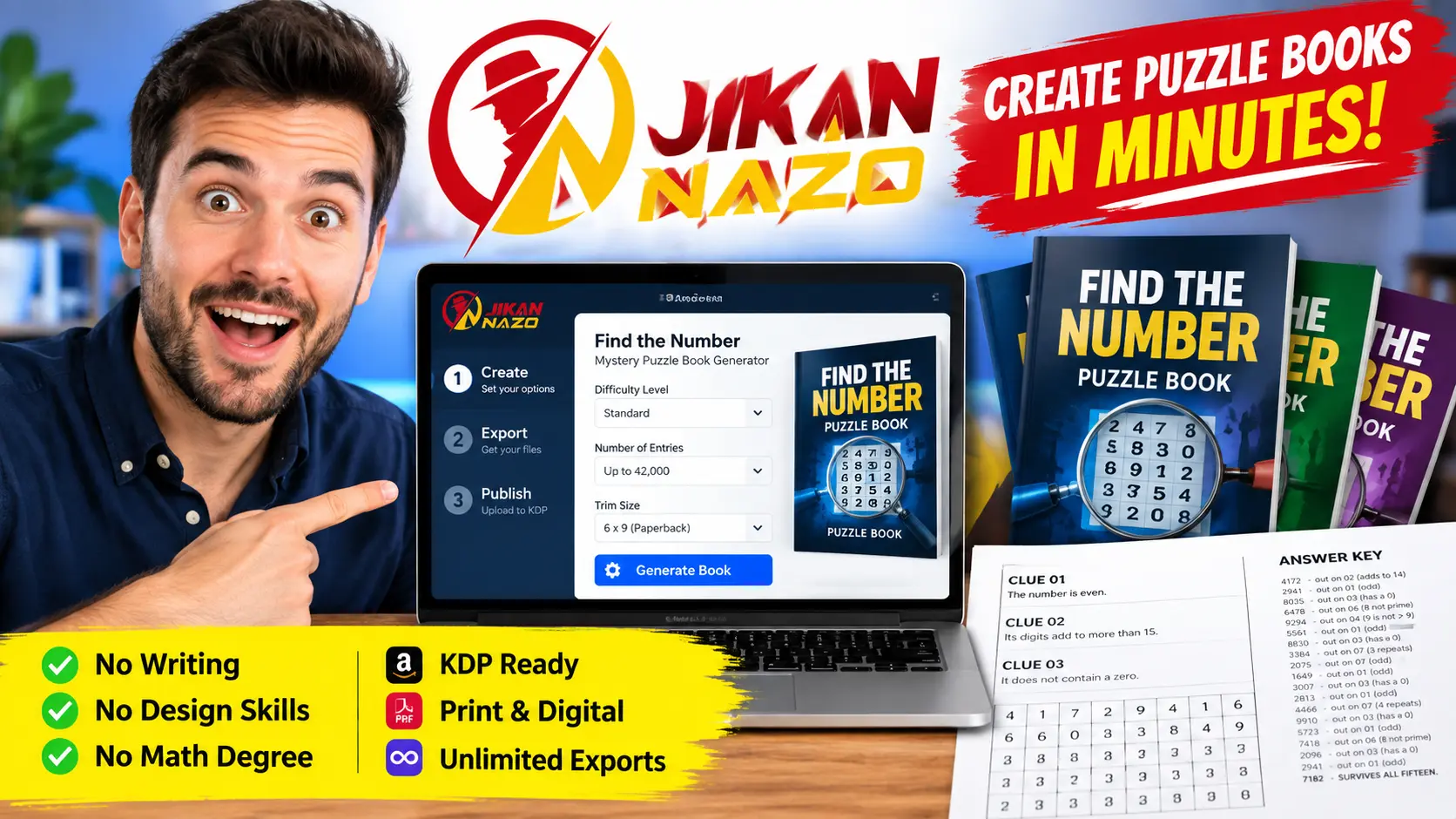
Jikan Nazo takes a different approach from conventional puzzle-book generators. Instead of focusing on familiar formats such as word searches, sudoku, or mazes, it is built around a find-the-number elimination mystery.
Readers receive a register containing many numbers and a series of clues. Each clue eliminates possibilities until one number remains.
For publishers, the interesting part isn't simply generating thousands of numbers. It's the software's claimed ability to generate, verify, format, and export complete puzzle books around this mechanism.
But there is an important distinction:
Jikan Nazo can automate puzzle production. It does not automatically create demand, sales, reviews, or a profitable KDP business.
So in this review, we'll look at what the software claims to do, how the puzzle system works, its publishing features, potential advantages and limitations, pricing considerations, and who should—and shouldn't—consider it.
Disclosure: Product capabilities and pricing discussed below are based primarily on the supplied Jikan Nazo sales-page information. Promotional claims, testimonials, and income examples should be treated as vendor-provided claims rather than guarantees of results.
>>>>> Visit Official Website <<<<<
Jikan Nazo at a Glance
| Feature | Jikan Nazo |
|---|---|
| Product type | Number-mystery puzzle generation software |
| Primary audience | KDP publishers and printable creators |
| Puzzle format | Find-the-number elimination mystery |
| Difficulty levels | Gentle, Standard, Fiendish |
| Claimed register capacity | Up to 42,000 entries |
| Solution system | Single-solution verification |
| Answer key | Per-clue elimination information |
| Large print | 18pt option |
| KDP formatting | Included according to the vendor |
| PNG exports | Unlimited according to the sales page |
| PDF exports | Up to 100 print-ready PDFs/month |
| Custom numbers | Supported |
| Custom chapter titles | Supported |
| Seeded generation | Supported |
| Recurring fee | Sales page states no recurring fee for the offer |
| Main use case | KDP puzzle books and printable products |
What Is Jikan Nazo?
Jikan Nazo is a specialized puzzle-generation tool designed around a number-elimination mystery.
The basic concept is easy to understand.
Imagine a page containing hundreds or thousands of possible numbers.
The reader receives clues such as:
The number is even.
Its digits add up to more than 15.
It does not contain zero.
The last digit is prime.
No digit repeats.
The reader crosses out numbers that fail each clue.
Eventually, only one number remains.
That number is the solution.
This gives the puzzle a mystery-style structure while retaining the mechanics of a logic and number puzzle.
For a KDP publisher, this creates a potentially different product angle from conventional puzzle books.
However, a different format is not automatically a profitable niche. Competition, demand, book quality, cover design, pricing, keywords, reviews, and positioning still matter.
How Does Jikan Nazo Work?
The Jikan Nazo workflow can broadly be divided into three stages.
1. Create the Puzzle
The publisher chooses settings such as difficulty, register size, and book configuration.
According to the supplied sales material, the software can generate a complete puzzle structure containing:
Number registers
Clues
Front matter
Rules
Chapter information
Answer material
Coded solutions
The sales page claims that the system can generate books containing up to 42,000 entries.
That is considerably different from manually creating a small collection of individual puzzles.
2. Verify the Puzzle
This is arguably the most important part of the product.
A number puzzle isn't useful if the clues leave two possible answers—or eliminate the correct answer completely.
The vendor says Jikan Nazo verifies that each generated puzzle has exactly one solution.
The sales page also describes an answer-key system that identifies entries eliminated by individual clues.
If this verification operates as described, it addresses a genuine production problem.
Generating content is relatively easy.
Generating content that remains logically valid throughout an entire book is considerably more difficult.
3. Export the Book
After generation and verification, the book can be prepared for publishing.
The supplied product information lists features including:
KDP trim-size support
Margins
Gutters
Bleed settings
Mirrored margins
Page numbers
Large-print 18pt formatting
Front matter
Back matter
Coded answers
Printable exports
The stated goal is to move the publisher from puzzle creation to a publishing-ready interior without manually formatting every page.
>>>>> Visit Official Website <<<<<
The Most Interesting Jikan Nazo Feature: Puzzle Verification
If you're comparing Jikan Nazo with a basic puzzle generator, this is the feature I would pay the most attention to.
A generator can produce numbers.
The harder problem is proving that the puzzle works.
Consider a hypothetical book containing hundreds of puzzles.
If even one puzzle has:
two possible solutions,
no valid solution,
an incorrect clue,
or an answer that doesn't match the clue set,
the reader may encounter a frustrating dead end.
That can affect the perceived quality of the entire book.
Jikan Nazo's stated solution is to build verification into the generation process.
The sales page describes three important ideas:
Exactly one surviving answer
Every clue must be true
The answer key identifies elimination witnesses
The vendor also claims that removing an individual clue can reopen the case, meaning the clues are intended to play meaningful roles rather than simply being decorative instructions.
That is a much more relevant differentiator than simply saying the software can “generate puzzles.”
Important qualification
These are product claims from the vendor. A buyer should distinguish between the stated functionality and independently testing the software with actual generated books.
For a serious publisher, I would generate several sample books, manually inspect the logic, review the exported files, and test the workflow before building a large catalog around it.
Jikan Nazo Features
Up to 42,000 Entries
The sales page states that Jikan Nazo can generate registers containing up to 42,000 entries.
That could be useful for publishers interested in creating larger puzzle books.
However, maximum capacity isn't necessarily the most important metric.
A better question is:
How enjoyable and solvable is the resulting puzzle at the register size you actually intend to publish?
A technically large book isn't automatically a better product.
Three Difficulty Levels
Jikan Nazo offers:
Gentle
Standard
Fiendish
This creates a natural opportunity for a series.
For example, a publisher could potentially organize products around beginner, intermediate, and advanced readers rather than putting every difficulty level into one book.
KDP Formatting
The sales page says the software handles publishing-related settings such as:
Trim sizes
Margins
Gutters
Bleed
Mirrored margins
Page numbers
Large-print formatting
The software also advertises a pre-flight check intended to help identify publishing-format issues.
This could save time compared with manually rebuilding interiors in Word, Canva, or another design application.
Still, publishers should inspect the final PDF themselves before uploading.
Software-generated formatting should never eliminate final quality control.
Large-Print Support
The product specifically promotes 18pt large-print output.
That opens another possible positioning direction for publishers interested in accessibility-oriented puzzle books.
However, publishers should still check the final visual result rather than assuming that selecting “large print” automatically produces a polished reader experience.
Custom Numbers and Titles
The supplied sales material says users can import their own number lists and customize chapter titles.
This could be useful for themed or personalized editions.
Potential concepts might include:
Gift books
Themed puzzle collections
Birthday editions
Anniversary editions
Classroom activities
Travel puzzles
Series-specific branding
The value here depends heavily on how creatively the publisher uses the functionality.
Seeded Generation
The software also advertises seeded generation.
In practical terms, the same seed can be used to reproduce the same generated book.
That can be useful for production workflows because a publisher can maintain consistency when rebuilding or adjusting the layout.
PNG and PDF Exports
According to the supplied sales page:
PNG exports are unlimited.
Print-ready PDF exports are limited to 100 per month.
This distinction matters.
A user creating a very large printable catalog should understand the difference between the two export systems and determine whether the monthly PDF allowance fits their intended workflow.
What Makes the Number-Mystery Format Different?
Traditional puzzle books are already familiar to consumers.
Examples include:
Word searches
Sudoku
Crosswords
Mazes
Logic grids
Number puzzles
The number-mystery format attempts to combine number logic with a mystery-solving experience.
Instead of simply asking the reader to complete a grid, the concept gives the reader a question:
Which number is the one that survives all the clues?
That framing could make the format easier to package as a mystery product.
Possible positioning could include:
Number detective puzzles
Secret-number mysteries
Logic investigations
Case-file puzzles
Number deduction challenges
Mystery brain games
But there is an important caveat.
A novel format still needs an audience
Being different does not automatically mean being in demand.
The publisher still needs to determine:
Who buys the book?
What age group is appropriate?
What difficulty do they prefer?
What price will they tolerate?
What cover communicates the concept?
What keywords accurately describe the product?
What competing products already exist?
That research is outside the software itself.
>>>>> Visit Official Website <<<<<
Is Jikan Nazo an AI Book Generator?
Not in the conventional sense.
Jikan Nazo is better described as a specialized puzzle-generation and publishing tool.
Its core purpose is not to generate arbitrary prose or write complete books like a general-purpose AI writing application.
The value is concentrated around its number-mystery puzzle engine, verification process, book construction, and export workflow.
That specialization can actually be an advantage for this particular use case.
A general AI tool might generate puzzle ideas, but generating a large collection of logically consistent number puzzles and validating their solutions is a different problem.
Jikan Nazo for Amazon KDP
KDP publishers typically need to solve several separate problems:
Product concept
Puzzle/content creation
Interior formatting
Cover design
Metadata
Keywords
Pricing
Publishing
Marketing
Quality control
Jikan Nazo mainly addresses part of that chain.
It can potentially help with:
Puzzle generation → verification → book construction → export
It does not eliminate the need for:
Market research → cover strategy → metadata → positioning → promotion → quality control
This distinction is important.
Jikan Nazo is production infrastructure, not a complete KDP business.
That is probably the most realistic way to think about the product.
Potential Jikan Nazo Publishing Ideas
The sales page itself suggests several directions.
1. Classic Number Mystery Books
The simplest approach is a traditional find-the-number puzzle collection.
Different volumes could target different difficulty levels.
2. Large-Print Puzzle Books
The 18pt option could support books aimed at readers who prefer larger text.
3. Difficulty-Based Series
A publisher could potentially build a progression:
Volume 1 → Gentle
Volume 2 → Standard
Volume 3 → Advanced/Fiendish
This provides a clearer series structure than publishing unrelated books.
4. Travel and Activity Books
Number mysteries could potentially be positioned as portable entertainment for:
Travel
Waiting rooms
Flights
Road trips
Vacations
5. Classroom Brain Games
Some puzzle formats can be adapted for educational or recreational settings.
However, any educational claims should be supported appropriately rather than simply labeling a puzzle as “educational.”
6. Personalized Books
The custom-number functionality could potentially be used for themed or personalized editions.
This is an area where creativity and positioning could matter more than the software itself.
Jikan Nazo Pros and Cons
Pros
Specialized puzzle engine
It is built around a clearly defined puzzle mechanic rather than being a generic content generator.
Claimed single-solution verification
This addresses one of the biggest technical problems associated with logic puzzles.
Multiple difficulty levels
Gentle, Standard, and Fiendish provide room for product differentiation.
KDP-oriented formatting
The supplied features cover several technical requirements that publishers otherwise have to handle manually.
Large-print option
The 18pt option provides another potential publishing angle.
Repeatable production
Seeded generation and batch-style workflows could be useful for publishers building a catalog.
Printable potential
The same underlying content may be usable for more than one distribution model.
Cons
It doesn't create demand
The software can generate products, but it cannot guarantee that shoppers want them.
The niche may become more competitive
If a particular puzzle format proves attractive, other publishers can enter the category.
Marketing remains your responsibility
You still need:
Good covers
Titles
Keywords
Descriptions
Pricing
Positioning
Quality control
More books aren't automatically better
A high-volume generation strategy can become counterproductive if the resulting catalog is repetitive or poorly positioned.
Upsells require careful evaluation
The front-end product and additional offers should be evaluated separately.
An upgrade is only valuable if its features solve a problem you actually have.
Results aren't guaranteed
The sales page itself includes an income disclaimer stating that testimonials are individual results and that earnings are not guaranteed.
>>>>> Visit Official Website <<<<<
Jikan Nazo Pricing: What Should You Look For?
Pricing is one area where you should be careful with sales-page information.
The supplied promotional material emphasizes launch pricing, bonuses, and a stated value calculation, but the exact final price may change during the promotion.
Therefore, rather than treating a temporary price as permanent, check the current checkout page before purchasing.
More importantly, don't evaluate Jikan Nazo solely by the headline discount.
Ask:
What is included in the front-end?
Which features are locked behind upgrades?
Are exports sufficient for my workflow?
Are there recurring charges?
Are PDF limits relevant to my publishing volume?
Do I actually need the additional tools?
Is the refund policy suitable for my situation?
Don't buy upgrades before you have a use case
This is particularly important for beginners.
Start with the functionality you actually need.
Create a sample book.
Test the puzzle logic.
Inspect the exported interior.
Then determine whether an upgrade solves a specific limitation.
That is more useful than buying every upgrade simply because the funnel presents them.
Is Jikan Nazo Legit?
Based on the supplied sales material, Jikan Nazo is presented as a functioning software product rather than merely an information course.
The sales page provides:
Product screenshots
Feature descriptions
Example puzzle output
Export information
User testimonials
Support references
Purchase information
Terms and privacy pages
However, legitimate software and profitable software are two different questions.
A tool can function exactly as advertised and still fail to produce commercial results for a particular publisher.
So the more useful question is not simply:
“Is Jikan Nazo legit?”
It is:
“Does the actual software provide enough value for my intended publishing workflow?”
That requires evaluating the product's actual output rather than relying exclusively on testimonials or sales-page claims.
Is Jikan Nazo a Scam?
There is no basis in the supplied information alone to characterize Jikan Nazo as a scam.
At the same time, buyers should not interpret sales-page claims as guaranteed outcomes.
The vendor's own disclaimer states that:
Results vary.
Testimonials are not typical.
Income is not guaranteed.
Business decisions involve risk.
That means screenshots showing royalties or sales should be viewed as examples of individual results, not forecasts of what a new purchaser should expect.
This is particularly important with KDP products because publishing success depends on factors outside the software.
Who Is Jikan Nazo Best Suited For?
Jikan Nazo may be worth investigating if you:
Already publish puzzle books.
Want to test a less conventional puzzle format.
Prefer automated generation over manual puzzle construction.
Want to build multiple related titles.
Value automated puzzle verification.
Want KDP-oriented interior generation.
Are comfortable conducting your own market research.
It could also appeal to a beginner who wants to experiment with puzzle publishing, provided they understand that the software does not replace basic KDP knowledge.
Who Should Avoid Jikan Nazo?
You may want to skip it if:
You don't intend to publish puzzle books.
You're looking for guaranteed passive income.
You already own several unused publishing tools.
You don't want to perform market research.
You expect software to generate sales automatically.
You plan to publish hundreds of books without quality control.
You're buying primarily because of a countdown timer or fear of missing out.
A cheap tool can still be expensive if you never use it.
Jikan Nazo vs. Manual Puzzle Creation
The biggest comparison isn't necessarily between Jikan Nazo and another software product.
It may be between automation and manual production.
| Factor | Manual Creation | Jikan Nazo |
|---|---|---|
| Number generation | Manual | Automated |
| Clue construction | Manual | Engine-generated |
| Solution checking | Manual | Claimed automated verification |
| Book assembly | Manual | Automated workflow |
| KDP formatting | Manual | Built-in features claimed |
| Scaling | Time-intensive | Designed for repeated generation |
| Quality control | Publisher responsibility | Verification + publisher review |
| Market research | Required | Required |
| Marketing | Required | Required |
The important point is that software does not eliminate the final responsibility.
Even if the engine verifies the puzzle mathematically, the publisher should still inspect the finished book.
What I Like Most About Jikan Nazo
The strongest part of the concept is not the claim that it can generate a large number of puzzles.
It's the attempt to solve the verification problem.
If you're producing a logic-based puzzle book manually, checking every relationship between clues and answers can become tedious.
A system that reliably handles this automatically could save considerable production time.
The second interesting element is the series potential.
The same basic mechanic can potentially be packaged into different difficulties, formats, themes, and audiences.
That makes the product more interesting for someone thinking about a catalog rather than one isolated title.
What I Would Be Careful About
The sales page places considerable emphasis on:
An apparently new niche
Revenue screenshots
Testimonials
Launch bonuses
Countdown timers
Large stated values
Those elements are common in direct-response software marketing.
They shouldn't be the primary reason to purchase.
Instead, focus on measurable product questions:
Can the software generate the puzzle format I want?
Does the verification work reliably?
Does the exported PDF require significant correction?
Can I create a professional-looking book?
Can I identify an audience for it?
Does the production time saved justify the cost?
Those are much better questions than whether other users have posted impressive revenue screenshots.
>>>>> Visit Official Website <<<<<
Jikan Nazo Review: My Overall Assessment
Jikan Nazo is interesting because it isn't simply another generic puzzle generator.
Its central proposition is a number-mystery format combined with automated puzzle verification and book-generation features.
That solves a real production problem.
But the software should be viewed as a publishing tool, not a business-in-a-box.
It can potentially help with:
Idea → Puzzle → Verification → Book → Export
You still need to handle:
Market → Positioning → Cover → Metadata → Pricing → Marketing → Quality Control
That distinction is critical.
So, is Jikan Nazo worth considering?
If your goal is to experiment with number-mystery puzzle books and you value automated generation and verification, the product has a logical use case.
If you're looking for guaranteed KDP income, it isn't the right expectation.
The sensible approach is to start with the functionality you actually need, create a sample product, inspect the results, and determine whether the workflow fits your publishing plans before investing further in optional upgrades.
In other words:
Don't buy Jikan Nazo because someone showed you a royalty screenshot.
Consider it because the software solves a production problem you actually have.
Frequently Asked Questions
What is Jikan Nazo?
Jikan Nazo is a specialized number-mystery puzzle engine designed to create elimination-style puzzle books for publishing and printable use.
How does a Jikan Nazo puzzle work?
Readers receive a register containing multiple numbers and a series of clues. They eliminate numbers that fail each clue until one number remains.
Does Jikan Nazo have different difficulty levels?
Yes. The supplied product information lists Gentle, Standard, and Fiendish difficulty levels.
How many numbers can Jikan Nazo generate?
The sales page claims that the engine can generate books with up to 42,000 entries.
Does Jikan Nazo verify the puzzles?
The vendor states that generated puzzles are verified to have exactly one solution and provides an answer-key system showing clue-based eliminations.
Can Jikan Nazo create KDP books?
The product is specifically marketed toward Amazon KDP publishers and includes KDP-oriented formatting features according to the supplied sales information.
Does Jikan Nazo support large print?
Yes. The sales page advertises 18pt large-print output.
Can I use my own numbers?
The sales material says that custom number imports are supported.
Does Jikan Nazo require a monthly subscription?
The supplied sales page states that the offer has no recurring fee. Buyers should nevertheless verify the current checkout terms before purchasing.
Can Jikan Nazo guarantee Amazon KDP sales?
No. The product's income disclaimer explicitly states that results vary and that earnings are not guaranteed.
Is Jikan Nazo an AI writing tool?
No. It is better categorized as a specialized puzzle-generation and verification tool rather than a general AI writing application.
Is Jikan Nazo suitable for beginners?
It may be, particularly for users who want to avoid manually constructing and checking large numbers of puzzles. However, beginners still need to understand KDP publishing, product positioning, covers, metadata, and quality control.
Does Jikan Nazo create the entire KDP business for you?
No.
It can automate parts of puzzle production and book preparation, but the publisher remains responsible for market research, product positioning, publishing decisions, and marketing.
>>>>> Visit Official Website <<<<<
Final Takeaway
Jikan Nazo is most interesting when viewed as production infrastructure for a specific puzzle category.
Its number-elimination mystery format gives publishers something different to experiment with, while the claimed verification system addresses an important problem in logic-puzzle production.
But the software itself isn't the business.
The real opportunity—or lack of opportunity—depends on what you do with the output.
If you can identify an audience, create an appealing product, package it effectively, and build a catalog around the concept, Jikan Nazo may have a useful role in that workflow.
If you're simply looking for a button that produces books and automatically generates royalties, the software cannot provide that.
The best reason to consider Jikan Nazo is not the promise of easy money. It's the potential to reduce the technical and repetitive work involved in creating verified number-mystery puzzle books.
Related Tags:
#JikanNazoReview #JikanNazoReview2026, #JikanNazo, #JikanNazoPricing, #JikanNazoPrice, #JikanNazoKDP, #JikanNazoPuzzleGenerator, #JikanNazoReviewKDP, #JikanNazoLegit, #JikanNazoScam, #JikanNazoBonuses, #JikanNazoUpgrades, #JikanNazoFeatures, #JikanNazoAlternative, #JikanNazoWorthIt, #JikanNazoNumberMystery, #KDPNumberPuzzleGenerator, #KDPPuzzleBookGenerator, #NumberMysteryPuzzleBooks
- #jikan-nazo-review
- #jikan-nazo
- #jikan-nazo-pricing
- #jikan-nazo-price
- #jikan-nazo-kdp
- #jikan-nazo-puzzle-generator
- #jikan-nazo-review-kdp
- #jikan-nazo-legit
- #jikan-nazo-scam
- #jikan-nazo-bonuses
- #jikan-nazo-upgrades
- #jikan-nazo-features
- #jikan-nazo-alternative
- #jikan-nazo-worth-it
- #jikan-nazo-number-mystery
- #kdp-number-puzzle-generator
- #kdp-puzzle-book-generator
- #number-mystery-puzzle-books
Comments
Join the discussionNo comments yet. Be the first to comment.