MagicFlix AI 2.0 Review: How AI Is Changing the Faceless Content Workflow
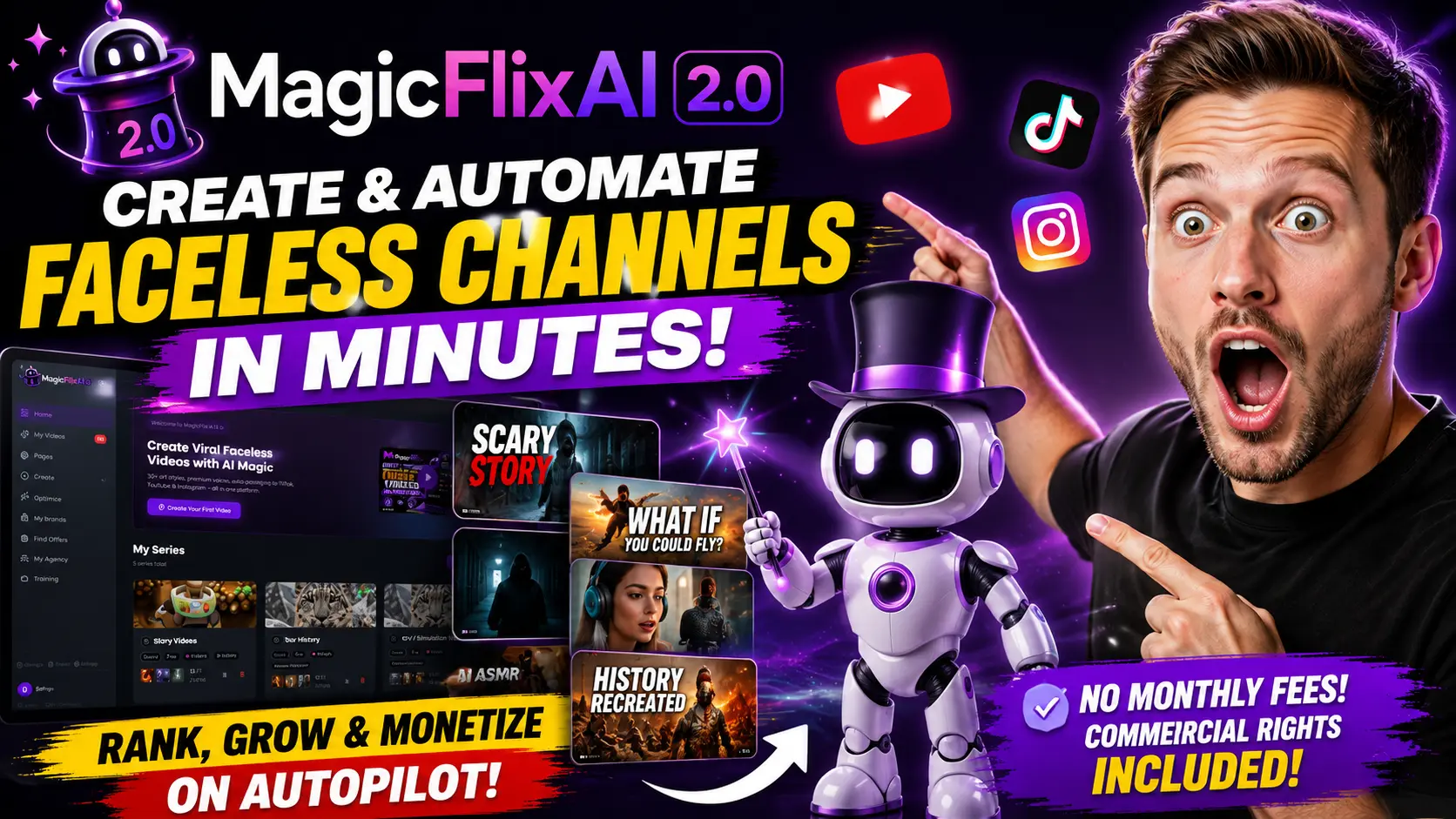
This MagicFlix AI review looks at MagicFlix AI 2.0 as an example of that shift — a platform built around bringing multiple stages of faceless video production into one connected system. The goal here isn't to tell you it's the only tool doing this or that it will single-handedly grow a channel for you. It's to walk through what an integrated AI workflow actually looks like in practice, what it can realistically help with, and where a creator's own judgment still matters.
Disclosure: This article may contain affiliate links. If you purchase through one of these links, I may receive a commission at no additional cost to you.
Introduction
Making a video used to require a fairly wide skill set, even for something short and simple. A creator would typically need to research a topic, develop it into an actual idea, write a script, record or source narration, find matching visuals, edit everything together, design a thumbnail, write titles and descriptions, and then publish on some kind of consistent schedule. That's a lot of different skills — writing, audio production, visual design, editing, and marketing — for one person to handle alone.
Generative AI has started to change that equation. Over the past couple of years, individual pieces of this workflow — scriptwriting, text-to-speech narration, AI-generated imagery — have each become dramatically more accessible on their own. The more interesting shift now is what happens when those individual capabilities start getting connected into a single workflow instead of staying as separate tools a creator has to manually stitch together.
This MagicFlix AI review looks at MagicFlix AI 2.0 as an example of that shift — a platform built around bringing multiple stages of faceless video production into one connected system. The goal here isn't to tell you it's the only tool doing this or that it will single-handedly grow a channel for you. It's to walk through what an integrated AI workflow actually looks like in practice, what it can realistically help with, and where a creator's own judgment still matters.
The central question worth asking about any tool in this category is this: is the real value of AI video software the ability to generate one video, or the ability to simplify the entire content workflow? That distinction matters, and it's the lens this review uses throughout.
>>>> CLICK HERE TO GET MAGICFLIXAI 2.0 <<<<
The Evolution of AI Video Creation
It's worth stepping back and looking at how AI-assisted video creation has generally progressed, since it helps explain where a platform like MagicFlix AI 2.0 fits.
Stage 1 — Individual AI Tools
The earliest and still most common version of this involves separate, standalone tools for each function: one app for AI writing, another for text-to-speech voice generation, another for AI image generation, another for basic video assembly, and a separate editor for final polish. Each tool does its job well in isolation, but the creator is responsible for manually moving output from one into the next.
Stage 2 — Connected Workflows
The next step has been tools that start linking a couple of these capabilities together — a script generator that feeds directly into a voice tool, for example, or a video generator that automatically pairs narration with matched visuals. This reduces some of the manual handoff, but usually only covers part of the full pipeline.
Stage 3 — Content Automation Platforms
The category MagicFlix AI 2.0 sits in tries to go further, aiming to connect research, ideation, scripting, production, optimization, and publishing into a single workflow. This doesn't mean any one piece of the technology is new — LLM-based scripting, TTS narration, and AI image generation have all existed independently for a while. What's different is the attempt to orchestrate them together so a creator isn't manually exporting and re-importing files at every stage.
To be clear, this isn't a claim that MagicFlix AI 2.0 is the first or only platform attempting this kind of integration — several tools in this space have been moving in a similar direction. It's simply where the category as a whole appears to be heading, and MagicFlix AI 2.0 is a useful example of what that looks like in practice.
>>>> CLICK HERE TO GET MAGICFLIXAI 2.0 <<<<
What Is MagicFlix AI?
In plain terms, MagicFlix AI 2.0 is a platform built around faceless video creation — content where a voice and visuals carry the story instead of a person appearing on camera — with AI handling much of the production mechanics along the way.
Its core focus areas include AI-assisted scripting, voiceover generation, visual selection or generation, basic video editing, SEO-related suggestions, scheduling, and publishing tools, aimed at reducing how many separate applications a creator needs to touch to get from an idea to a finished, published video.
It's worth drawing a clear line here between AI-assisted creation and fully autonomous content production. AI-assisted creation means the software generates drafts, suggestions, and assembled output that a creator reviews, adjusts, and approves. Fully autonomous production would mean content going from idea to publication with no human review at all. Even with automation features switched on, this MagicFlix AI 2.0 review treats the platform as falling into the first category — a tool that speeds up production, not one that replaces the need to check what it produces before it goes live.
Inside the Content Workflow
The general production sequence looks like this:
Idea → Script → Voice → Visuals → Editing → SEO → Publishing
Idea — A topic or concept, either chosen from a theme or described by the creator.
Script — An AI-generated draft based on that idea, covering structure and tone.
Voice — AI narration reading the script aloud.
Visuals — Images or video clips matched to the script content.
Editing — Assembling narration and visuals into a coherent, timed video.
SEO — Titles, descriptions, and tags generated or suggested for discoverability.
Publishing — Scheduling and posting the finished video to one or more platforms.
The potential advantage of running all of this through one connected system, rather than switching between five or six separate apps, comes down to a few practical things: less tool switching, fewer manual file transfers between programs, a more consistent production process from video to video, potentially faster turnaround, and generally easier content management once you're producing more than a handful of videos.
There's a trade-off worth naming honestly, though. An integrated platform is convenient specifically because it makes reasonable defaults and handles the connective tissue between stages for you. Specialized standalone tools — a dedicated professional editor, for instance — can often offer deeper customization in their specific domain than an all-in-one platform will. Whether that trade-off matters to you depends on how much manual control you actually want at each stage.
>>>> CLICK HERE TO GET MAGICFLIXAI 2.0 <<<<
AI Story and Script Generation
Scripting remains one of the most important parts of any faceless video, since it's what everything else — narration, visuals, pacing — is built around. A strong script with a weak voice or mediocre visuals can still hold attention; a weak script rarely gets saved by good production values.
AI can meaningfully help with several parts of this stage: developing a raw idea into a workable topic, drafting hooks for the opening seconds, building outlines, structuring a narrative or explanation, generating full scripts, and producing tonal variations (more casual, more dramatic, more instructional) for the same underlying idea.
What a creator should still review before treating a generated script as finished:
Accuracy — particularly for any factual claims, statistics, or historical details
Originality — whether the script reads as distinct or as a fairly generic pattern
Repetition — phrasing or structure that recurs in ways that feel formulaic
Tone — whether it actually matches the intended audience and channel voice
Audience relevance — whether the content genuinely serves the viewers it's meant for
Factual claims — anything stated as fact that should be independently verified
AI-generated scripts are best treated as strong starting points, not guaranteed finished products. The review and editing step is where a script goes from "technically correct" to "actually good," and that step still requires a human.
>>>> CLICK HERE TO GET MAGICFLIXAI 2.0 <<<<
Visual and Voice Creation
Faceless content leans heavily on two components doing the work a presenter would normally do: voice and visuals.
AI Voice
Narration quality affects viewer trust and retention more than most beginners expect. Things worth paying attention to include voice consistency across an entire video (and across a channel's back catalog), correct pronunciation — especially for names or technical terms — natural pacing that matches the content's complexity, and a delivery style that doesn't sound flat or obviously synthetic.
AI Visuals
On the visual side, this usually means AI-generated images, video clips, or some mix of both, matched to specific sections of the script. Good visual storytelling means the imagery on screen actually supports what's being said, with scene changes timed to keep pacing natural rather than static or rushed.
For AI video generation specifically, it's worth being realistic: matching visuals to narration is a genuinely tricky technical problem, and generated or auto-matched visuals won't always land perfectly on the first pass. Reviewing whether the visuals actually fit each scene — rather than assuming an automatic match is always correct — is a worthwhile habit. It's also worth understanding the licensing terms attached to whatever visual and audio assets a platform provides, since that's the creator's responsibility regardless of which tool generated the content.
Automated Editing
Editing has traditionally been one of the more time-consuming and technically demanding parts of video production — timeline assembly, arranging scenes in the right order, syncing voice to visuals, adding transitions, adjusting timing, adding captions, and finally rendering the output.
AI content automation in this context generally handles the mechanical side of these tasks: placing assets on a timeline, aligning narration and visuals, and applying basic transitions, without requiring a creator to manually adjust every frame. For a lot of faceless content — where the goal is a clean, watchable result rather than a highly stylized production — that level of automation covers most of what's actually needed.
That said, professional editors working on more demanding projects, or anyone who wants precise manual control over color grading, layered effects, or detailed audio mixing, will often still prefer dedicated, specialized editing software for final polish. Automated editing removes repetitive work; it doesn't necessarily replace the ceiling that professional tools offer.
>>>> CLICK HERE TO GET MAGICFLIXAI 2.0 <<<<
SEO Optimization
Getting a video made is only half the challenge — helping it actually get discovered is the other half. This is where keyword research, titles, descriptions, hashtags, search-intent alignment, topic selection, and thumbnails all come into play.
AI-assisted SEO tools can meaningfully speed up this process by suggesting keywords, drafting title and description options, and surfacing relevant hashtags based on your content and niche. That's a genuine time-saver, especially for beginners who don't have SEO experience.
What this kind of assistance cannot do is guarantee Google rankings, YouTube rankings, viral traffic, view counts, or subscriber growth. Search and recommendation systems weigh dozens of signals beyond metadata — audience engagement, watch time, click-through rate, and platform-specific algorithm behavior all matter more than title optimization alone. Content quality and genuine audience satisfaction remain the biggest levers here, and no metadata tool changes that.
Multi-Platform Publishing
Most creators today aren't publishing to just one platform. YouTube, TikTok, and Instagram each have distinct audiences, formats, and expectations, and distributing content across more than one can meaningfully expand reach — if the content is adapted properly for each one.
Scheduling and publishing automation can help maintain consistency by reducing the manual work of logging into each platform separately to upload content. That's a real, practical benefit for solo creators trying to keep a regular posting schedule.
It's worth being clear, though, that the same piece of content usually can't just be copy-pasted across platforms unchanged. Format (vertical vs. horizontal), length, opening hooks, captions, titles, and calls to action often need platform-specific adjustment to actually perform well. Scheduling tools solve the consistency problem, not the platform-fit problem — that part still requires understanding how each platform's audience behaves.
This review doesn't claim MagicFlix AI 2.0 integrates with any specific platform's publishing API beyond what's described in the platform's own materials — that's a detail worth verifying directly if it matters to your workflow.
Monetization
Faceless content channels can pursue several realistic monetization paths: YouTube advertising revenue, affiliate marketing, sponsorships, digital products, lead generation for a separate business, or driving traffic to a website.
Here's the important distinction: content automation can support monetization, but it does not create guaranteed income. A platform that makes it easier to produce content and embed affiliate links or sponsor mentions is addressing the production side of the equation. Whether any of that actually converts into revenue depends on your niche, the size and trust of your audience, your traffic volume, the quality of your content, your actual conversion rates, your specific monetization strategy, ongoing platform policy compliance, and how consistently you publish over time.
None of those variables are things a production tool controls. Be skeptical of any tool — this one included — that implies otherwise.
Pros and Cons
Pros:
Integrated workflow covering scripting, voice, visuals, editing, SEO, and publishing
Built specifically around faceless content, with no on-camera requirement
Multiple production functions in one place rather than several disconnected tools
Potential time savings compared to a fully manual, multi-tool process
Content automation for repetitive production tasks
SEO-related suggestions for titles, descriptions, and keywords
Scheduling capabilities for maintaining publishing consistency
Structured, guided workflow that's generally approachable for beginners
Cons:
AI-generated scripts, voice, and visuals still require human review before publishing
Output can feel generic without deliberate customization
Automation and scheduling don't guarantee views, rankings, or income
Beginners still need to develop real content strategy and niche understanding
Advanced or professional creators may want more granular manual control
Platform-specific policies still apply and require independent attention
Features, pricing, and bonuses can change, especially around launch periods
Specialized standalone tools may offer deeper capabilities in specific areas (like professional editing)
>>>> CLICK HERE TO GET MAGICFLIXAI 2.0 <<<<
Who Should Consider It?
Potentially a good fit for:
Beginners who don't want to learn and coordinate several separate tools
Faceless content creators building a channel without appearing on camera
YouTube creators looking to reduce production time
Affiliate marketers wanting monetization built into their content workflow
Solo entrepreneurs managing content production alone
Social media creators publishing across multiple platforms
Anyone whose main bottleneck is the repetitive mechanics of production rather than strategy or ideas
May not be ideal for:
Professional editors who need advanced, granular manual control
Creators who already have a mature, specialized production workflow that works well for them
Anyone expecting guaranteed income from the tool itself
People unwilling to review and adjust AI-generated material before publishing
Final Verdict
So, how is MagicFlix AI 2.0 changing the faceless content workflow? Its main appeal isn't really any single AI feature — scripting, voice generation, and AI visuals all exist as capable standalone tools elsewhere. The more meaningful shift is bringing script generation, voice, visuals, editing, SEO, scheduling, and publishing into one connected workflow, so a creator isn't manually moving files between five or six separate applications for every video.
Who should consider it comes down to where your actual bottleneck is. If your biggest challenge is managing multiple repetitive stages of faceless content production — juggling separate tools for writing, voice, visuals, and editing — the integrated workflow this kind of platform offers may genuinely be worth exploring. If you already have a specialized, working production stack and need advanced manual control over specific stages, the value proposition looks different, and a more targeted tool might serve you better.
Either way, it's worth reviewing the current features and pricing directly before deciding, since offers and included tools can change over time.
>>>> CLICK HERE TO GET MAGICFLIXAI 2.0 <<<<
Frequently Asked Questions
1. What is MagicFlix AI 2.0? MagicFlix AI 2.0 is a platform built around AI-assisted faceless video creation, combining scripting, voiceover generation, visuals, editing, SEO suggestions, and publishing tools into a single connected workflow rather than requiring several separate applications.
2. Is MagicFlix AI suitable for beginners? The guided, step-by-step workflow is generally approachable for people with little to no video production background. That said, beginners still need to develop a clear content strategy and review AI-generated output before publishing.
3. Can MagicFlix AI create faceless videos? Yes, faceless video creation is the platform's core focus, using AI-generated narration and visuals in place of an on-camera presenter, which is the primary use case it's built around.
4. What does AI content automation mean? It generally refers to reducing manual, repetitive production tasks — like scripting, voice generation, and editing — by connecting them into an automated pipeline. It does not mean content is published without any human involvement or review.
5. Does MagicFlix AI help with video SEO? It includes tools for suggesting titles, descriptions, keywords, and hashtags to support discoverability. These suggestions can save research time but don't guarantee rankings or traffic, which depend on many additional factors.
6. Can MagicFlix AI publish content automatically? The platform includes scheduling and publishing tools intended to help maintain a consistent posting rhythm across platforms like YouTube, TikTok, and Instagram, reducing the need for manual uploads on each one.
7. Is MagicFlix AI 2.0 worth considering? It depends on your goals. If reducing the repetitive mechanics of faceless video production is your main challenge, it may be worth evaluating. If you're expecting guaranteed income or views, it's important to set realistic expectations, since no automation tool can promise those outcomes.
Related Tags:
#MagicFlixAI2.0, #MagicFlixAI2_0, #MagicFlixAI2Review, #MagicFlixAIReview, #MagicFlixAI2026, #AIVideoGenerator, #FacelessYouTube, #FacelessChannel, #YouTubeAutomation, #AIYouTube, #YouTubeChannel, #AIMarketing, #AffiliateMarketing, #YouTubeMonetization, #AIVideo, #MakeMoneyOnline, #FacelessVideo, #AIContentCreation, #YouTubeGrowth, #YouTubeTips, #YouTubeSEO, #VideoMarketing, #AIContent, #OnlineBusiness, #DigitalMarketing
Comments
Join the discussionNo comments yet. Be the first to comment.