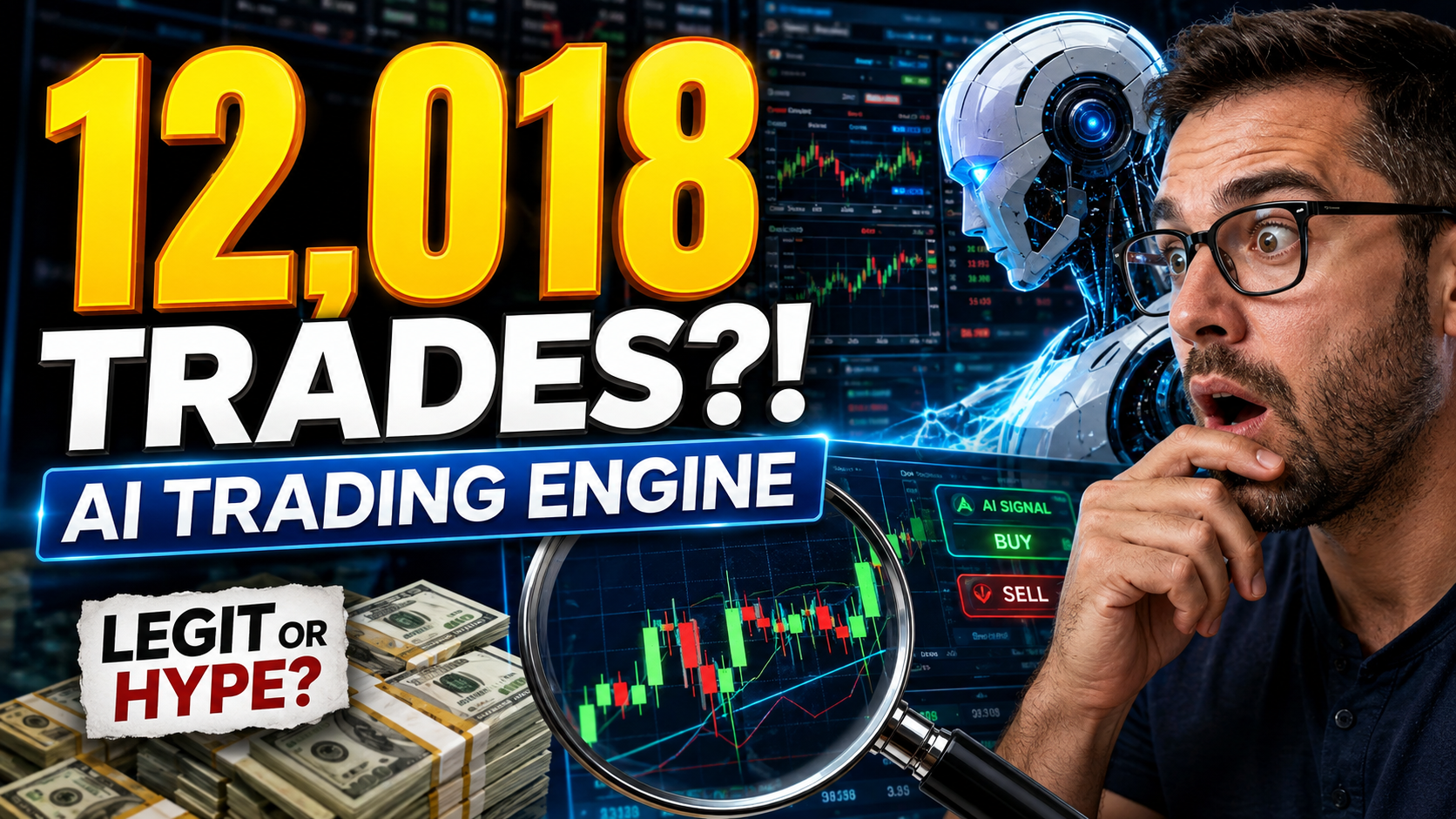
AI Trading Engine Review 2026: Don't Buy Before Reading This
This AI Trading Engine review 2026 walks through what the product is, how it says it works, who's behind it, the Wayland AI agent, the Palantir example, the features, the realistic pros and cons, and whether the claims hold up to scrutiny — so you can make your own call before the cart opens.
Introduction
Affiliate Disclosure: This article may contain affiliate links. If you purchase through a link on this page, I may receive a commission at no additional cost to you. This does not influence my assessment, and you should always do your own research before purchasing any product or financial-related service.
If you've spent any time on trading Twitter or in your inbox lately, you've probably seen a version of this pitch before: a slick pre-launch funnel, a countdown clock, a "case study" screenshot, and a promise that this is finally the AI tool that turns your existing subscriptions into money. That's the exact setup surrounding The AI Trading Engine, a product from marketer Sean Donahoe launching September 1, 2026.
The pre-launch sequence is built around a three-video series, a free AI agent called Wayland, and a single Palantir trade example that's doing a lot of the heavy lifting in the marketing. Before you hand over your card details on launch day, it's worth slowing down and actually looking at what's being claimed, what's been shown, and what's still unverified.
This AI Trading Engine review 2026 walks through what the product is, how it says it works, who's behind it, the Wayland AI agent, the Palantir example, the features, the realistic pros and cons, and whether the claims hold up to scrutiny — so you can make your own call before the cart opens.
What Is The AI Trading Engine?
The AI Trading Engine is marketed as an AI-assisted stock research and trade-idea system. It's built to run on top of Wayland, a free AI agent that installs on your own Mac or Windows computer. The pitch is that Wayland scans a list of stocks overnight, on its own schedule, and produces a written brief each morning with a potential trade idea, an entry point, and suggested places to sell.
It's worth being precise about the category this falls into, because the marketing language can blur it:
AI-assisted analysis means software helps you research and organize information, but you still decide what to do with it.
Automated trading means software places trades on your behalf without your intervention.
Guaranteed-profit systems are products that claim a specific, assured financial outcome — something no legitimate trading tool can honestly promise, because markets are unpredictable.
Based on the material available, The AI Trading Engine positions itself in the first category: it says it produces a brief and a recommendation, and the human makes the final call. That's a meaningfully different (and more defensible) claim than "this AI trades for you and makes you money." But it's a claim worth verifying for yourself once you're inside the product, not something to take purely on faith from a sales page. No AI-based tool — however well designed — removes the underlying risk that markets can move against you.
Who Is Behind The AI Trading Engine?
The product is created by Sean Donahoe, operating through ADD Marketing Group, LLC. According to his own materials, he has been building and marketing online for roughly 27 years and describes himself as having sold over $25 million worth of digital products.
It's important to separate two different kinds of track record here:
Track record as a product creator/marketer — the figures around products sold, affiliate payouts, and marketplace rankings relate to his history launching and selling info-products and software online.
Track record as a trader — the marketing references "27 years" and "his own process" in trading, but doesn't provide independently verifiable trading statements, audited results, or a long-term public track record of trades.
Neither of these is unusual for this type of launch, but readers should recognize that being a successful product marketer and being a successful trader are two different skill sets, and the public information available doesn't let you verify the second one directly. If a verifiable trading track record matters to your decision, that's something to look for explicitly before buying — not something to assume from marketing copy alone.
How Does The AI Trading Engine Work?
Based on the available information, the apparent workflow looks like this:
Wayland (installed locally) → overnight scan of a stock list → AI-generated analysis → a written morning brief → potential entry/exit levels → the user decides whether to act
The system is described as covering a set list of stocks, running the same checks each night, and surfacing the ones that meet its criteria, ranked with reasoning attached. The final decision — whether to place any trade at all — is described as staying with the user; the tool is said not to execute trades automatically.
This puts it closer to a decision-support and research tool than a fully automated trading bot, at least as described. Whether that holds up once you're inside the platform is something only a hands-on trial can confirm. If automation, order execution, or account connectivity is something you're evaluating, that's a specific question worth asking (or testing) before you commit money, not something to infer from a features list.
What Is Wayland?
Wayland is described as the AI agent that the trading system runs on top of. A few specifics from the provided material:
It's a free AI agent.
It's available for both Mac and Windows.
It runs locally, on the user's own computer, rather than on a remote server.
Installation is described as taking about one minute.
The instructions given to users are simple: download it, open it once, allow it to run, and leave it installed.
The appeal of a locally-run agent is understandable — it suggests your data and trading ideas aren't sitting on someone else's server, and there's no subscription fee attached to the core agent itself.
That said, "free and local" doesn't mean "no due diligence required." Before installing any third-party desktop application — AI agent or otherwise — it's reasonable to check what permissions it requests, what data it accesses on your machine, whether it needs ongoing internet access, and what its privacy policy actually says. This applies to any software, not just this one, but it's especially worth doing before you connect a piece of software to anything involving your finances or a brokerage/charting account.
The Palantir Case Study Explained
This is probably the single most important section of this review, because it's the centerpiece of the marketing.
According to the vendor's material:
On August 4, the AI reportedly identified Palantir stock at $162.66 and produced a brief naming four potential places to sell.
On August 19 — 15 days later — the follow-up example showed the price at $171.54.
The vendor describes this as roughly a 5.5% increase over 15 days.
Doing the math independently: moving from $162.66 to $171.54 is an increase of about $8.88, or approximately 5.46%, which is consistent with the "about 5.5%" figure being presented.
That part checks out as arithmetic. What it doesn't tell you is everything else that determines whether a real trade based on this idea would have actually been profitable for a real person:
Market volatility — a single 15-day window on one stock says nothing about how the same approach performs across dozens of trades, different stocks, or different market conditions.
Entry timing — did the brief say to buy immediately at $162.66, or was there a suggested entry range? Small timing differences change real-world results.
Exit timing — the brief reportedly listed four places to sell. Which one, if any, would a real trader have hit, and when?
Position size — a 5.5% move means very different things in dollar terms depending on how much capital was actually put behind the idea.
Trading costs and slippage — commissions, spreads, and the difference between a quoted price and your actual fill price all eat into returns.
Taxes — short-term gains are typically taxed differently than long-term ones, and that affects what you actually keep.
Risk management — what would have happened if Palantir had moved the other direction instead? A single winning example doesn't show you the losing side of the same process.
None of this means the example is fabricated or dishonest. It means one historical example is not a performance record. A single case study — even a real, accurately-reported one — cannot tell you what to expect from using this tool over the next month, quarter, or year. Treat it as an illustration of how the tool presents information, not as evidence of expected returns.
Key Features
Based on what's been described, here's what the product appears to offer, along with what's worth verifying yourself:
| Feature | What it appears to do | What to verify |
|---|---|---|
| Overnight stock scans | Wayland checks a list of stocks on a schedule | How many stocks, how often, and what criteria are used |
| Morning trading brief | A written summary with a trade idea and reasoning | Whether the reasoning is detailed enough to actually evaluate |
| Entry/exit levels | Suggested price points for a given idea | Whether these are static or adjust in real time |
| Local AI agent (Wayland) | Runs on your own computer, not a remote server | Data access, permissions, and system requirements |
| Human-in-the-loop | The tool reportedly does not place trades itself | Confirm this directly — this is a meaningful safety claim worth testing |
| Practice-account training | The live class is described as being run on a paper-trading account | Confirm no real capital is required during the training week |
Potential Benefits
If the described functionality works as presented, some plausible upsides include:
Time savings on research — scanning a watchlist manually every night is tedious; software doing the first pass could be a genuine convenience.
A more structured process — having a written brief with stated reasoning is arguably better than making impulsive, emotion-driven trades.
Beginner accessibility — a system that explains its reasoning, rather than issuing unexplained signals, gives newer traders something to learn from rather than just follow blindly.
No server-side subscription for the core agent — Wayland itself being free and local removes one ongoing cost.
Paper-trading first — if the training period genuinely uses a practice account, that's a reasonable, lower-risk way to test the workflow before risking real money.
Again: these are potential benefits based on how the product is described, not guaranteed outcomes. Whether they materialize for you depends on execution, market conditions, and your own trading discipline.
What I Don't Like About The AI Trading Engine
To be a fair reviewer, it's worth naming the concerns plainly:
Trading always involves risk. No AI tool changes that basic fact, no matter how the reasoning is presented.
AI predictions can be wrong. A model that explains its reasoning clearly can still be wrong — clarity of explanation isn't the same as accuracy.
Past performance doesn't guarantee future results. This applies to the Palantir example and to any future track record the tool might build.
One case study is one data point. A larger, independently verified sample of trades would tell you far more than a single 15-day example.
The launch structure carries the hallmarks of a high-pressure marketing funnel — countdown timers, a hard cart close, tiered upsells, and an affiliate prize pool are common in the info-product world. None of that makes the underlying product illegitimate, but it's a reason to slow down rather than buy on urgency.
Pricing has multiple layers. Beyond the front-end price, there's an order bump with a recurring monthly fee after a free trial, plus two additional upsells and a separate high-ticket bundle offered only during the live webinar. It's worth mapping out the full potential cost before you buy anything.
Software compatibility and permissions should be checked before installing Wayland or connecting any charting/brokerage account to it.
Refund terms and purchase conditions should be read directly on the official checkout page — not assumed.
None of these points are unique to this launch — they're standard due-diligence items for any trading-adjacent software purchase, and they apply whether or not the product turns out to be genuinely useful.
Is The AI Trading Engine a Scam?
This is the question most readers actually want answered, so let's be direct about it.
A "scam," in the meaningful sense, typically involves things like: no real product being delivered, guaranteed-profit promises, fake identities, or outright fabricated results. Based on the information available here, this doesn't appear to be that. There's a named, identifiable vendor, a described product with a specific mechanism, a free component (Wayland) that exists independently of the purchase, and no explicit language guaranteeing profits.
What it is, clearly, is an aggressively marketed launch — countdown clocks, urgency-driven cart closes, tiered pricing, and a competitive affiliate structure are all standard tools of internet product launches, and they're present here in a big way. Aggressive marketing and legitimacy aren't mutually exclusive, but aggressive marketing does mean you should evaluate the underlying claims more carefully, not less.
I would not call it a scam based solely on the information available, but I would also not treat the marketing claims as proof of guaranteed trading profits. The honest position is: there isn't enough independently verified performance data here to confirm the strategy works reliably, and there isn't evidence of outright fraud either. It sits in the large, ordinary middle ground of "unproven claims from a real product," which is exactly why due diligence matters before you buy.
Is The AI Trading Engine Legit?
Here's a balanced, subjective breakdown based on what's publicly described:
Product concept: Reasonable. AI-assisted research paired with human decision-making is a defensible, non-exotic approach.
Ease of use: Appears accessible — a roughly one-minute local install and a single daily brief is a low-friction workflow, on paper.
Transparency: Mixed. The vendor is named and identifiable, and the tool reportedly shows its reasoning. But the trading track record behind the "27 years" claim isn't independently documented, and only one case study is provided.
Risk level: Same as any discretionary trading approach — real risk exists regardless of the tool used to generate the idea.
Value: Hard to assess without confirmed, complete pricing and a clear view of what's inside each tier versus what's an upsell.
Overall: A product with a plausible concept and a real, named vendor, wrapped in a high-pressure launch funnel and backed by a single unverified case study. Worth a closer look if the concept interests you — not worth buying purely because the countdown clock says so.
Who Should Consider It?
This may be worth investigating if you:
Are genuinely curious about AI-assisted stock research and want to see how it's implemented.
Want a more structured, documented trading process rather than making impulsive calls.
Understand — and accept — that trading carries real risk regardless of what tool you use.
Are comfortable critically evaluating AI-generated analysis rather than following it blindly.
Enjoy exploring new trading and AI technology as a hobby or professional interest, separate from any promise of profit.
Who Should Avoid It?
You should be cautious, or likely pass, if you:
Expect guaranteed profits from any trading tool — none can honestly offer that.
Cannot afford to lose money you'd put behind any resulting trade ideas.
Are looking for a completely passive income stream with no ongoing decisions or oversight from you.
Don't yet understand basic investment risk and haven't traded before.
Would be inclined to follow AI-generated signals automatically, without your own review.
Are not comfortable installing third-party desktop software or evaluating what access it requests.
AI Trading Engine Pros and Cons
| Pros | Cons |
|---|---|
| Human stays in control of trade decisions (as described) | Trading risk is not eliminated by AI involvement |
| Wayland, the underlying AI agent, is free | Only one case study (Palantir) has been publicly shown |
| Local install — runs on your own computer | Vendor's "27 years" trading claim isn't independently documented |
| Reasoning is reportedly attached to each brief | Multiple upsell tiers add complexity to total cost |
| Training reportedly uses a practice/paper account | Countdown-driven, high-pressure launch structure |
| Beginner-accessible workflow, on paper | No guarantee the tool performs consistently going forward |
AI Trading Engine Pricing
Based on the vendor's own launch materials, the pricing structure is tiered:
Front-end offer: a five-day live training program, priced at $47.
Order bump: an add-on companion offering, billed at $29/month after an initial free trial period.
First upsell: an expanded offering priced at $97.
Second upsell: a further expanded offering priced at $197.
Webinar-only bundle: a combined package (including an additional standalone intensive) offered only during the live launch webinar, priced at $497.
Keep in mind that upsells and bundles are optional, and the total you'd actually spend depends entirely on which tiers you choose to add. As with any launch, exact pricing, what's included at each tier, and current refund terms can change — always confirm final pricing and terms directly on the official checkout page when doors open, rather than relying on any third-party summary, including this one.
Frequently Asked Questions
What is the AI Trading Engine?
It's an AI-assisted stock research product from Sean Donahoe that produces a daily trading brief based on overnight analysis, built on top of a free AI agent called Wayland. It's described as a decision-support tool, not an automated trading bot.
What is Wayland?
Wayland is a free AI agent that installs and runs locally on your own Mac or Windows computer. The AI Trading Engine is built to run on top of it.
Is Wayland free?
Yes, according to the vendor, Wayland itself is free to download and use, independent of whether you purchase the trading course.
Does Wayland work on Windows?
Yes, Windows is listed as a supported platform.
Does Wayland work on Mac?
Yes, Mac is also listed as a supported platform.
Is AI Trading Engine suitable for beginners?
It's marketed toward beginners, and the training period reportedly uses a paper/practice trading account rather than real money. Beginners should still make sure they understand basic trading risk before purchasing.
Can AI Trading Engine guarantee profits?
No. No legitimate trading tool can guarantee profits, and nothing in the available material claims otherwise. Any product implying guaranteed returns should be treated with serious skepticism.
Is AI Trading Engine a scam?
Based on the information available, there isn't clear evidence of fraud — there's a named vendor and a described product. However, the trading claims aren't independently verified, so treat the marketing claims with healthy skepticism rather than as proof.
What is the Palantir case study?
It's a single example the vendor shared showing the AI identifying Palantir at $162.66 on August 4, with a follow-up 15 days later on August 19 showing $171.54 — roughly a 5.5% move. It's presented as an illustration, not a guaranteed or typical result.
When does AI Trading Engine launch?
The doors are scheduled to open Tuesday, September 1, 2026, at 10 AM ET, following a webinar, with the general cart opening at 11 AM ET the same day.
Do I need trading experience?
No prior experience is required based on the marketing, since the training reportedly starts from the basics and uses a paper-trading account. That said, understanding basic trading concepts before you start will help you evaluate whether the tool's suggestions make sense.
Is there financial risk?
Any time you place a real trade based on the tool's output, yes — normal market risk applies. The training period itself is reported to use a practice account, which removes risk during that specific window, but any live trading afterward carries the same risk as any other trading activity.
AI Trading Engine Review 2026: My Final Verdict
The AI Trading Engine is a plausible, reasonably well-explained AI research and trade-idea tool, wrapped in a very typical high-pressure product launch. The concept — a locally-run AI agent that scans stocks overnight and hands you a written brief with reasoning, while leaving the final trade decision to you — is not far-fetched, and it's a more defensible pitch than the "fully automated guaranteed income" claims you see in a lot of AI trading marketing.
That said, the evidence provided so far is thin. One case study, however accurately reported, is not a track record. The vendor's long trading history isn't independently documented in the material available, even though his history as a product marketer is well established. And the launch itself — countdown timers, a hard cart close, tiered upsells, and a competitive affiliate structure — is designed to create urgency, which is exactly the environment where careful evaluation matters most.
If you're curious about AI-assisted trading tools, understand the risks involved, and want to explore the concept, this may be worth a closer look once doors open — ideally by testing the free Wayland agent and reading the actual materials for yourself rather than deciding based on the pre-launch hype alone. If you're hoping for a guaranteed, passive way to make money, or you're not in a position to risk any capital, this isn't the product for that, and no honest trading tool would claim to be.
Before spending anything, verify the final pricing, read the actual refund policy, understand exactly what each upsell adds, and don't let a single 15-day case study or a countdown clock make the decision for you.
AI can genuinely help with research, organization, and structuring a process — but it cannot eliminate market risk, and it cannot guarantee profits. Keep that in mind no matter how good the next case study looks.
Disclaimer: The information in this article is for educational and informational purposes only and should not be considered financial or investment advice. Trading stocks and other financial instruments involves risk, and you can lose money. Past performance or historical examples do not guarantee future results. Always conduct your own research and consider consulting a qualified financial professional before making investment decisions.
Related Tags:
#AITradingEngine #AITradingEngineReview #AITrading #AIStockTrading #TradingAI #WaylandAI #StockMarketAI #AIInvesting #TradingTechnology #AITradingSoftware #TradingTools2026 #StockAnalysisAI #AITradingReview2026 #FintechAI #TradingBotReview #AIForTraders #BeginnerTrading #StockTradingTips #AIResearchTool #TradingSystemReview #InvestingWithAI #MarketAnalysisAI #TradingSoftwareReview #AIAgentTrading #SmartTradingTools
Comments
Join the discussionNo comments yet. Be the first to comment.